
Rapper-turned-politician Balendra Shah's Rastriya Swatantra Party (RSP) is poised to form the next government in Nepal after a decisive victory in the general election, significantly impacting established political parties.

Nepal's Madhesi Peoples Rights Forum-Democratic, the second largest partner in the ruling Maoist-led coalition, today suffered a jolt as 10 of its top leaders quit from the party to form a new group.
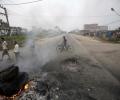
Rajendra Mahato, the chairman of Sadhbhawana Party, was injured in police action in Biratnagar on Saturday.
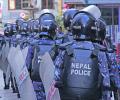
A 19-year-old Indian was killed as Nepal police opened fire on people demonstrating against the new Constitution near the Indo-Nepal border, hours after security forces baton-charged Madhesi protesters and evicted them from a key bridge in the area in a pre-dawn swoop.
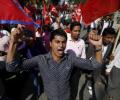
The United Democratic Madhesi Front said that in view of the severe shortage the country is facing, the blockade has been called off. However, the agitation will continue.
The agitating parties will launch protest rally in Ratnapark of Kathmandu on Saturday and sit-in in front of the Singhdurbar Secretariat.
The Madhes-based parties have been protesting for over four months against the seven-province model proposed in the new Constitution that divides their ancestral land.
New Delhi said it stands ready, as always, to extend its full support to the efforts of the government and people of Nepal in the ongoing process of democratic transition in which "significant milestones" have already been achieved.

'Gyanendra back on the throne would be bad news for the Nepali people. He may not have learnt from his experience, but we have.'

The 70-year-old was the only contender in the election.

The Shiv Sena on Monday refused to call off the protest against the book launch of former Pakistan Foreign Minister Khurshid Mahmud Kasuri in Mumbai.
Two senior Nepalese leaders, including the chief of the ruling party, on Tuesday left for India, where they are set to meet the Indian leadership, as the political crisis in Nepal deepened with the Maoists stepping up their protests to destabilise the government.
In a major breakthrough, Nepal's ruling coalition partners on Saturday sorted out the vexed issue of portfolio distribution and power sharing after they 'tentatively agreed to a deal' to give the 20-day-old Communist Party of Nepal-Unified Marxist Leninist government a "full shape" by Sunday.
The Communist Party of Nepal-Maoist, Nepali Congress, CPN-UML and Madhesi People's Rights Forum (MPRF) at a meeting held Monday night agreed in principle to form a coalition government under the leadership of former rebels, NC spokesman Arjun Narsingh Khatri Chhetri said.

K P Sharma Oli was elected as the next prime minister of Nepal on Sunday defeating incumbent Sushil Koirala in a contest which became necessary after parties failed to forge a consensus amid violent protests over the country's new Constitution.

Nepal Prime Minister Sushil Koirala on Saturday resigned even as Parliament prepares to elect a new premier tomorrow after parties failed to forge a consensus amid continued protests and blockade of a key border trade point with India over the country's new Constitution.
After the clash on Wednesday, 29 dead bodies were recovered from the site and 40 Maoists, who sustained injuries have been admitted to the local hospital for treatment.

Three Madhesi leaders have supported Prachanda's candidacy.

It's intriguing that the prime minister now wants his American partner to help protect the Hindu minority in Bangladesh. That's conceding to the Americans a pre-eminence India has always contested, resented and feared, asserts Shekhar Gupta.
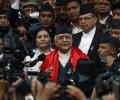
Nineteen parties in the Parliament have already confirmed that they will be voting in favour of the no-confidence motion.

'Neither State should take the matter into a terrain that involves tension -- and certainly not war.'

A day after premier K P Oli resigned, Nepal President called on all the political parties to elect a new prime minister within a week
In a move that could potentially irk New Delhi, China has offered to supply liquified petroleum gas to Nepal after gifting fuel to ease the crisis in the country, hit by acute fuel shortage due to a blockade at key border trade points with India.

India has rejected as "totally false" allegations that it blockaded a key trade checkpoint on the border with Nepal amid protests over that country's new constitution even as it emphasised that it is for the Nepalese people and parties to find a mutually acceptable solution.
Deuba was elected as the 40th prime minister on June 6 with the support from Communist Party of Nepal-Maoist Centre, which is now a part of Left alliance and opting for merger with Communist Party of Nepal-Unified Marxist-Leninist.

During his visit, Mukherjee visited the hotbed of Madhesi protests Janakpur and met ex-servicemen of Gurkha regiments in Pokhra.

India on Tuesday strongly condemned as "provocative" and "ill-intentioned" allegations that it is sending soldiers in plain clothes to Nepal amid the ongoing agitation against the new Constitution by Indian-origin Madhesis.

Nepal on Sunday adopted its new fully secular and democratic constitution, achieved after seven years of painstaking deliberations, amid violent protests by minority Madhesi groups over a seven province federal structure.
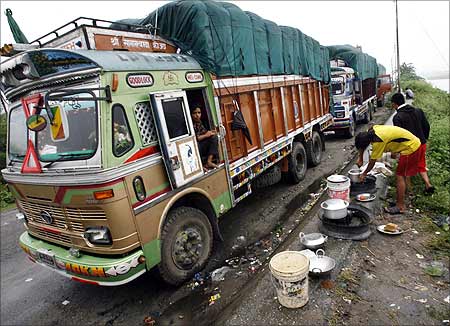
Nepal's Cabinet on Monday passed a special resolution asking India to open the border entry points to ease supplies of essential goods like medicines, gas and petroleum to the landlocked country, reeling under acute shortage due to blockade of key trade points.

Rejecting the allegation of adopting "big brotherly" approach towards Nepal, India on said it respects its sovereignty and wants to see the crisis resolved through consensus.

As Nepal undergoes a political transition, India on Friday pitched for implementing the country's Constitution by accommodating aspirations of all sections and assured it of all possible support amid China's efforts to gain ground in the Himalayan nation.

'Keeping its financial interests in mind, China wants no enmity with the Nepalese government.'

The main contest is likely to be between the Maoists and the Nepali Congress, but neither of the parties have retained the support they had in 2008. Shubha Singh reports
Within the SAARC framework, says Rajeev Sharma, Nepal's strategic importance cannot be overestimated as Nepal is a key member of the sub-SAARC group India has created to bypass Pakistan.

Whether it is Sri Lanka, Maldives, or Nepal, quietly but steadily, India has been reclaiming some of the ground it had lost to China, observes Aditi Phadnis.
Amid the political limbo over government formation, Indian-origin Madhesi leader Ram Baran Yadav was sworn-in as the first President of the nascent republic of Nepal on Wednesday, three days after his victory in the historic poll for the coveted post.

'We should not have waited for the political crisis in Nepal to erupt before being galvanised into action,' says Shyam Saran. 'We should have seen what was coming and not accepted assurances from the leaders of the political parties at their face value.'

Nepal's constituent assembly on Monday rejected calls to remove the key term secularism from the new constitution and revert the Himalayan nation to a Hindu state, triggering protests by Hindu activists.

India's unpopularity coincides with China lengthening its shadows in Nepal, says Rajeev Sharma.

The contrived controversy over the so-called blockade of the India-Nepal border has obscured the perilous path on which the current ruling elite in Nepal are taking the country towards.
 © 2026 Rediff.com - Advertise with us - Disclaimer - Privacy Policy - Sitemap - Feedback - About us - Terms of use - Grievances